Are OEM Certified Diesel Mechanics Worth It?
Cory Smith · · 10 min read
Last Updated: November 13, 2026
Quick Summary
OEM certified mechanics matter because they carry factory software that reads every module on the truck and the manufacturer's exact repair procedures, including the calibration and relearn steps a repair requires. Generic scan tools read emissions codes and little else, so guessing at a fault code costs you parts you never needed. Certification also produces the documentation a warranty reviewer asks for.
- OEM certification gives technicians factory software access and the exact repair procedures the builder publishes.
- ASE T Series exams cover medium and heavy-duty trucks and are separate from automotive certification.
- A manufacturer can deny a specific claim when a non-conforming part or off-procedure repair caused the failure.
- Replacing a turbocharger when the real fault is a boost leak is a common costly misdiagnosis.
- Swapping a fuel injector without programming new trim values can cause rough running, codes, and higher fuel burn.
Table of Contents
- What OEM Certification Means for Diesel Engine Diagnostics
- ASE Diesel Certification and the ASE T Series Explained
- OEM Certified vs. Non-Certified Mechanics: Pros and Cons
- How OEM Certification Protects Your Powertrain Warranty and Resale Value
- The Hidden Cost of Improper Repairs on Heavy-Duty Truck Repair
- Dispatch an OEM-Level Technician to Your Rig
- Frequently Asked Questions
What OEM Certification Means for Diesel Engine Diagnostics
OEM certification means a technician has completed the manufacturer's own training program for a specific engine platform, giving them factory software access and the exact repair procedures the builder publishes. OEM certification matters on every diagnostic call.
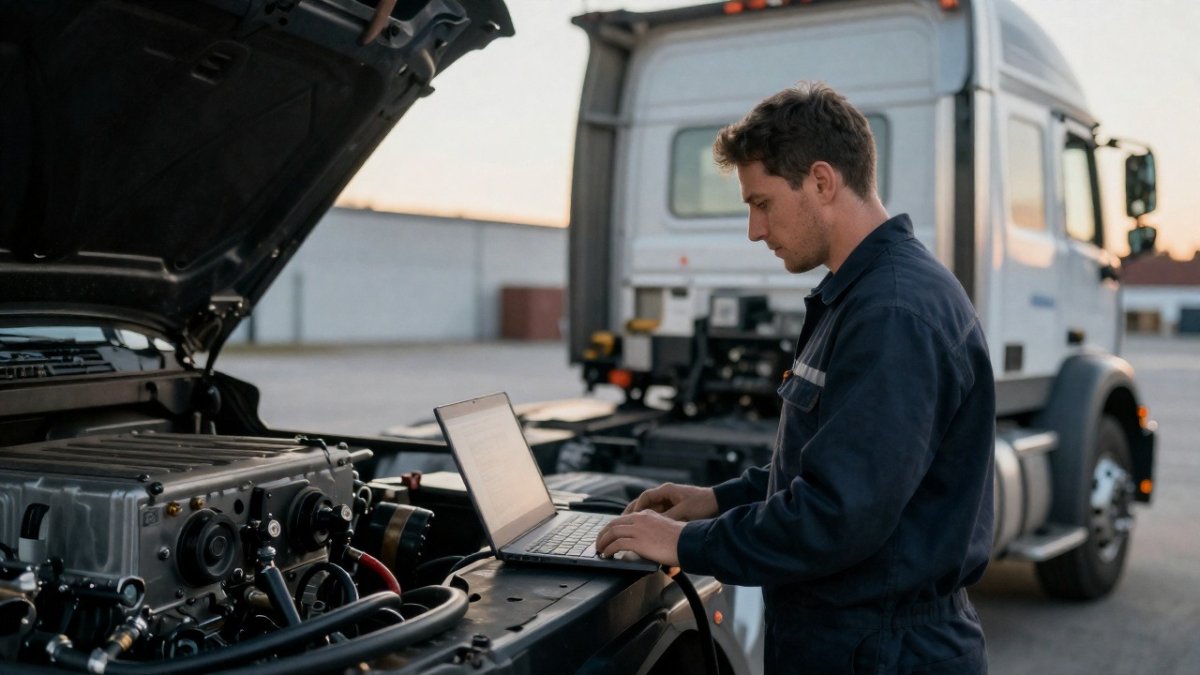
Generic scan tools read emissions codes and little else. Factory software reads every module on the truck, including the ones that talk to each other over the J1939 data network.
Factory Software Access and ECU Calibration
Calibration matters most after a repair. Swap a fuel injector without programming the new trim values and the engine can run rough, set codes, and burn more fuel than it should.
ASE Diesel Certification and the ASE T Series Explained
ASE diesel certification is a national credential earned by passing standardized tests, and the ASE T Series is the set of exams covering medium and heavy-duty trucks. It is a separate track from automotive certification, so a great car mechanic is not automatically qualified on an 80,000-pound rig.
The National Institute for Automotive Service Excellence administers these exams, and certification requires passing the tests plus documented work experience. The credential is not a substitute for manufacturer training, but the two together tell you a technician has both broad fundamentals and platform-specific knowledge.
What the ASE T Series Tests Cover
The T Series exams test diesel engines, drive trains, brakes, suspension, electrical systems, and preventive maintenance inspection (Medium-Heavy Truck Certification Tests, T Series: T1-T8). Each test is multiple choice and timed, and passing requires real diagnostic reasoning, not memorized answers. A technician holding several T Series certifications has proven knowledge across the systems that actually strand a truck.
OEM Certified vs. Non-Certified Mechanics: Pros and Cons
OEM certified mechanics bring factory training, current software, and documented repair procedures. Non-certified mechanics can still be skilled, and for straightforward mechanical work the difference may not matter. Here is the honest comparison.
| Factor | OEM Certified | Non-Certified |
|---|---|---|
| Diagnostic software | Factory-level, all modules | Generic scan tool, limited codes |
| Calibration after repair | Supported | Often unavailable |
| Warranty alignment | Matches manufacturer procedure | May void coverage |
| Best for | Electrical faults, emissions, no-starts | Basic mechanical repairs |
The trade-off is cost and availability. Certified mobile service can carry a higher rate than a general shop, and you are paying for the right diagnosis the first time. If you want to compare what diagnostics cost against standard repair rates, our pricing page lays out the rates before you commit.
How OEM Certification Protects Your Powertrain Warranty and Resale Value
Warranty protection is the argument every competitor makes, but the mechanism is what matters. Under the Magnuson-Moss Warranty Act, a manufacturer generally cannot void a warranty solely because an independent shop did the work (the FTC). What it can do is deny a specific claim when it can show the failure was caused by a non-conforming part or a repair performed outside published procedure.
When a claim is filed, the manufacturer's reviewer typically asks for the repair order, the diagnostic scan report, the part numbers installed, and any calibration or relearn records. A repair performed to manufacturer procedure produces all four. A repair performed on guesswork produces an invoice that says "replaced sensor" with no scan data behind it, and that is the file that gets denied.
The Liability Exposure Fleet Managers Rarely Price In
This is the angle most articles on OEM certification never touch. For a fleet, the exposure is not just a denied warranty claim on one truck. If a non-certified repair on a critical engine system, fuel delivery, aftertreatment, or the ECU itself, contributes to a breakdown, a roadside incident, or an emissions violation, the fleet operator carries the liability.
A documented paper trail is one of the most useful forms of protection for a fleet. Our warranty information lays out how we document parts and labor coverage so that file exists before anyone asks for it.
Why Resale Value Follows the Records, Not the Mileage
Resale value is a documentation story. A fleet buyer or a dealer appraising a used truck looks for a continuous service history with part numbers and calibration records, because those records are the only evidence the engine was maintained to the specification the manufacturer built it to. Gaps in that history do not just lower the offer, they raise the question of what happened during the gap. A truck with documented OEM-level diagnostics and calibration records sells faster and holds value better than an identical truck with a patchwork of undocumented fixes, and the gap widens on emissions-equipped engines where calibration history is verifiable through the ECU itself.
The Hidden Cost of Improper Repairs on Heavy-Duty Truck Repair
Improper repairs cost more than the original job, and the reason is that the first invoice is the smallest one.
Watch out: a common costly pattern is replacing a turbocharger when the real fault is a boost leak, a stuck variable-geometry actuator, or a failed sensor. The new turbo does not fix the underlying fault, and the customer may still need the actual repair. A proper diesel engine diagnostics session finds the cause before anyone touches a wrench.
OEM vs. Aftermarket Parts Compatibility
This is the part of the cost story competitors skip. Modern diesel engines are built around proprietary software and parts that are calibrated to a specific engine serial number and emissions configuration. An aftermarket part that is dimensionally correct can still be electronically incompatible, the ECU expects a specific sensor response curve or injector trim value, and a part that does not match it will set codes, derate the engine, or run the aftertreatment system outside its design window. The part is not defective. It is simply not the part the software was written for. OEM certification matters here because the technician has the manufacturer's parts catalog and the factory software to confirm compatibility before the part goes on, not after the code comes back.
Software and ECU Calibration: The Cost of a Missing Relearn
A modern diesel engine is software-heavy, and the calibration is part of the repair. Swap a fuel injector without programming the new trim values and the engine runs rough, sets codes, and burns more fuel than it should. Replace an aftertreatment component without running the manufacturer's relearn and the system may not regen correctly, which shortens the life of the replacement part. None of these failures show up on the repair invoice.
We service the major platforms, and you can confirm your engine platform is covered before dispatch so the right software and the right parts catalog arrive with the technician.
Dispatch an OEM-Level Technician to Your Rig
When your truck is down, the fastest path back to the road is a technician who arrives with the right software and knows your engine.
To get moving, send your GPS location, truck details, and fault codes to our dispatch center and we will match the right technician to your platform. For OEM-level electrical and diagnostic work specifically, see our electrical and OEM diagnostics service.
If a fault code has you parked and guessing, stop guessing. Smith Truck Repair brings 24/7 mobile heavy-duty and RV service to your location, with OEM-level diagnostics, bumper-to-bumper repair capability, and on-site fleet maintenance that keeps your trucks earning. Get started with Smith Truck Repair and get your rig diagnosed right the first time.
Frequently Asked Questions
Do diesel mechanics need ASE certification?
ASE certification is voluntary, but it is the standard most fleets and insurers look for. The ASE T Series covers medium and heavy-duty trucks, including diesel engines, brakes, and drivetrain. A passing score shows tested knowledge, not just years on the job. Pair it with OEM factory training and you get a technician who understands both general repair standards and the specific software and service intervals your engine maker requires.
What is the difference between OEM and ASE diesel certification?
ASE diesel certification is an independent, industry-wide credential that tests general heavy-duty repair knowledge. OEM certification comes from the manufacturer and covers that brand's proprietary software, technical bulletins, and calibration procedures. ASE proves broad competence; OEM proves the technician can work inside your specific engine's diagnostic system. Most strong shops hold both, because each one covers ground the other does not.
How can I verify that a diesel mechanic is OEM-certified?
Ask for the certification number and the manufacturer it covers, then check the maker's service locator or certification portal. ASE credentials can be confirmed through the ASE website. A shop doing OEM-level diagnostics should also be able to show you the factory software it uses and the repair documentation it produces. If a provider cannot name the program or the software, treat the claim as marketing rather than a credential.
Can an OEM-certified mechanic help reduce truck downtime?
Yes, mainly through faster and more accurate diagnosis. Factory software reads the fault codes and live data specific to your engine, so the technician finds the failed component instead of replacing parts by guesswork. Accurate diagnosis means fewer return visits and less time in the bay. For fleet managers, that directly protects vehicle uptime and operational efficiency, especially when the work is done on site instead of after a tow.
